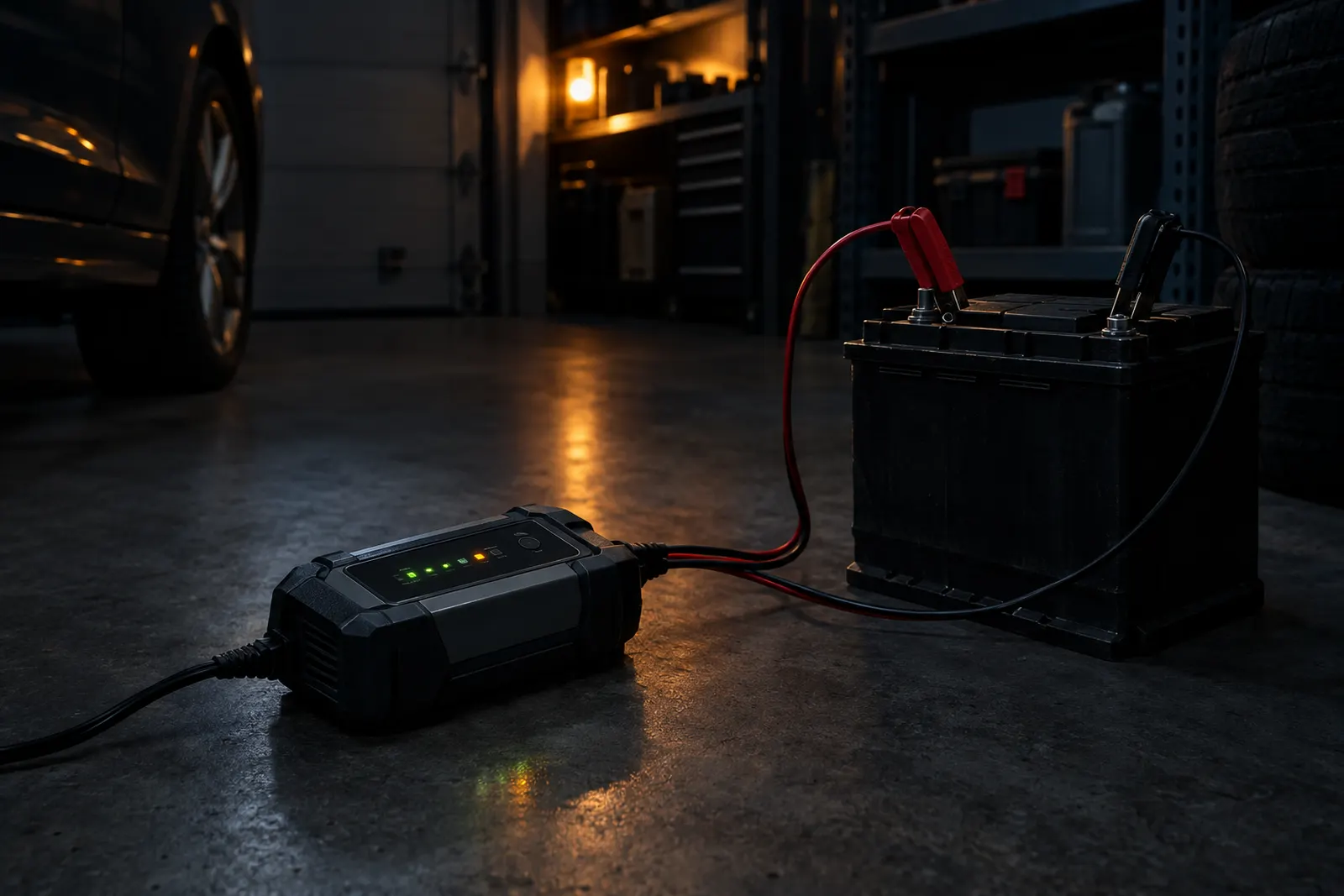
The NEXPEAK 10A Charger is our top pick for its budget positioning, screen and claimed support for 12V and 24V lead-acid batteries. Its higher stated charging current and maintenance mode make it a practical feature-rich option for drivers seeking more than a basic maintainer.

Best Car Battery Chargers UK 2026: 12V Smart and Trickle Chargers Ranked
How we make money: we may earn a commission if you buy through our Amazon links, at no extra cost to you. Rankings are based on research, not payment. How we rank · Disclosure
The right car battery charger can bring a flat battery back to health and keep a car, motorbike or campervan ready to start through the winter. This guide ranks the current top 10 Amazon UK best-selling car battery chargers for 2026, including 12V smart chargers, trickle chargers and maintainers, and chargers for AGM, stop-start and lithium batteries. Our order is based on research into specifications and thousands of UK owner reviews, not hands-on testing.
Our top recommendation is the NEXPEAK 10A Charger, which combines higher claimed charging output, a display and a maintenance mode at a budget level. For a budget-friendly alternative with selectable modes and broad battery-type claims, the Aptliton 15A Charger is our Best budget pick. The list also includes established and versatile choices from CTEK and NOCO, plus compact maintainers for smaller batteries.
The Aptliton 15A Charger is our Best budget pick, offering a high stated charging current, a screen and selectable modes. Its broad battery-type claims may suit drivers looking for flexibility without moving beyond a budget-priced option.
A proven, easy-to-use 5A charger for charging and maintaining a wide range of 12V vehicle batteries.
Best car battery charger for your battery: quick picks
Best 12V smart car battery charger
NEXPEAK 10A Charger ranked #1
A 10A output, an LCD with charging readings and maintenance mode for lead-acid, AGM and gel batteries.
See it in the rankingsBest trickle charger for a car
CTEK MXS 5.0 ranked #2
A well-established 5A charger built around automatic charging and long-term maintenance.
See it in the rankingsBest AGM and stop-start battery charger
Aptliton 15A Charger ranked #3
Selectable Start-Stop mode, with support for AGM, EFB and LiFePO4 batteries from 2Ah to 200Ah.
See it in the rankingsBest charger for leisure and lithium batteries
NOCO GENIUS10 ranked #6
A 10A output that charges batteries up to 230Ah, with 12V LiFePO4 support and a 3-year warranty.
See it in the rankingsBest motorbike battery charger
MOTOPOWER MP00205A ranked #7
A low-cost 0.8A maintainer with SAE connections, clamps and ring-terminal leads.
See it in the rankings
At a glance: the top 10
| Rank | Product | Score | Buy |
|---|---|---|---|
| 1 | NEXPEAK 10A Charger Best overall Budget |
8.9 | Amazon |
| 2 | CTEK MXS 5.0 Runner-up Mid-range |
8.9 | Amazon |
| 3 | Aptliton 15A Charger Best budget pick Budget |
8.7 | Amazon |
| 4 | PROFIKLA 8A Charger Best value with an LCD Budget |
8.7 | Amazon |
| 5 | NOCO GENIUS5 Best versatile mid-range pick Mid-range |
8.6 | Amazon |
| 6 | NOCO GENIUS10 Best for larger batteries Premium |
8.2 | Amazon |
| 7 | MOTOPOWER MP00205A Best budget maintainer Budget |
8.2 | Amazon |
| 8 | NOCO GENIUS2 Best compact all-rounder Mid-range |
8.1 | Amazon |
| 9 | NOCO GENIUS1 Best for small batteries Mid-range |
8.0 | Amazon |
| 10 | Xtremeauto 6A Charger Best low-cost 6A option Budget |
7.9 | Amazon |
Price bands: Budget Mid-range Premium show where each product sits against the other nine in this guide, based on typical Amazon UK prices when we last checked. Prices change often, so tap through to see today's price.
The battery chargers ranked, 1 to 10
A budget-priced 10A charger with a screen and claimed 12V/24V support for lead-acid batteries.
- Output
- 12V 10A / 24V 5A, according to the listing
- Battery types
- Lead-acid, AGM, gel, SLA and flooded
- Display
- LCD with charging status and readings
- Other functions
- Maintenance, pulse repair and temperature compensation
- Warranty
- 2 years
Pros
- Claimed 10A output for 12V batteries
- Supports 12V and 24V lead-acid batteries
- LCD shows charging readings and status
- Maintenance mode and two-year limited warranty
Cons
- Leads may be too short for some setups
- No lithium compatibility listed
- Cannot activate or charge a totally dead battery
Best for: Drivers wanting higher charging current, a display and a maintenance mode without a premium price.
Skip it if: You need lithium support, very long leads or charging for a completely dead battery.
A proven, easy-to-use 5A charger for charging and maintaining a wide range of 12V vehicle batteries.
- Output
- 12V, 5A
- Battery types
- Various vehicle batteries; check the manual for compatibility
- Connections
- Crocodile clamps and ring terminals
- Charging
- Automatic; temperature compensation
- Other functions
- Maintenance and battery reconditioning
Pros
- Automatic 12V charging and maintenance
- Temperature compensation for changing conditions
- Includes crocodile clamps and ring terminals
- AGM and reconditioning modes
Cons
- 5A output is not aimed at fast charging
- Not suitable for lithium batteries
- Some owners find the leads short or the price high
Best for: Drivers who want a well-established charger for regular battery care and long-term maintenance.
Skip it if: You need lithium-battery support, a fast high-current charger or the lowest-cost option.
A high-current charger with a screen and broad battery-type claims at a budget-friendly level.
- Output
- 12V/24V claimed; up to 15A
- Battery types
- Lead-acid, AGM, EFB and LiFePO4
- Capacity range
- 2–200Ah, according to the listing
- Display
- LCD touchscreen
- Modes
- Auto, Start-Stop, Motorbike and Maintenance
- Warranty
- 1 year
Pros
- LCD shows charging information
- Selectable modes for different uses
- Claims compatibility with several battery types
- Budget-friendly feature set
Cons
- 24V charging performance is questioned by an owner
- Display may be difficult to read in bright light
- Instructions and lead length draw criticism
Best for: Drivers seeking selectable modes, a clear charging display and compatibility beyond standard lead-acid batteries.
Skip it if: You need established long-term reliability or depend on the claimed 24V performance for demanding use.
A budget 8A charger offering multiple modes and a useful screen for routine charging and maintenance.
- Output
- 12V/24V claimed; up to 8A
- Battery types
- Lead-acid, AGM, gel, calcium, MF, SLA, VRLA and wet
- Capacity range
- 6–150Ah at 12V; 6–100Ah at 24V, according to the listing
- Display
- LCD with charge status and readings
- Modes
- Car/Truck, Motorcycle, AGM and Repair
- Warranty
- 1 year
Pros
- LCD shows charging status and useful readings
- Modes for cars, motorbikes, AGM and repair
- Claims compatibility with several lead-acid battery types
- Compact, budget-priced option for routine charging
Cons
- 24V capability is disputed by a buyer
- Instructions are sparse, especially for repair mode
- No listed lithium support or jump-start function
Best for: Drivers wanting a low-cost charger with a display and settings for cars, motorbikes and AGM batteries.
Skip it if: You require verified 24V operation, lithium compatibility or detailed, polished instructions.
A versatile 5A smart charger with support for 6V and 12V batteries, including LiFePO4.
- Output
- 6V/12V, 5A
- Battery types
- Lead-acid and 12V LiFePO4
- Capacity
- Charges up to 120Ah; maintains all sizes
- Connections
- Clamps and M6 eyelet terminals
- Other functions
- Temperature compensation and Force Mode
- Warranty
- 3 years
Pros
- Works with 6V and 12V lead-acid batteries
- Supports 12V LiFePO4 batteries
- Maintains batteries of any size, according to the listing
- Includes clamps, M6 eyelets and temperature compensation
Cons
- 5A output is slow for larger, deeply discharged batteries
- Leads may be too short for some parking setups
- One owner found the status display small
Best for: Households with cars, bikes or leisure batteries that need charging as well as long-term maintenance.
Skip it if: You want a low-cost basic maintainer or need more than 5A for faster charging.
A powerful 10A smart charger for larger batteries, with broad battery-type support and maintenance features.
- Output
- 6V/12V, 10A
- Battery types
- Lead-acid and 12V LiFePO4
- Capacity
- Charges up to 230Ah; maintains all sizes
- Connections
- Clamps and eyelet terminals
- Other functions
- Temperature compensation, Force Mode and repair mode
- Warranty
- 3 years
Pros
- 10A output suits larger batteries
- Supports lead-acid and 12V LiFePO4
- Can maintain batteries of all sizes
- Clamps and eyelet terminals included
Cons
- Premium price may be excessive for small batteries
- Multiple modes and indicator lights can take learning
- Repair mode does not reliably restore every battery
Best for: Owners of larger cars, campervans or leisure batteries who want higher output and smart maintenance.
Skip it if: You only need to maintain a motorbike battery or want a cheaper, simpler charger.
A simple, affordable 12V maintainer with useful ring-terminal and clamp leads included.
- Output
- 12V, 0.8A
- Battery types
- 12V lead-acid, including AGM and gel
- Connections
- SAE, with clamps and ring-terminal leads
- Capacity
- Charges motorbike batteries up to 30Ah; slowly charges car batteries up to 80Ah
- Warranty
- 2 years
Pros
- Affordable, simple 12V maintenance
- Supports AGM, gel and other lead-acid batteries
- Includes clamp and ring-terminal leads
- Automatic operation and two-year warranty
Cons
- Low 0.8A output means slow charging
- Does not support 6V or lithium batteries
- Some owners find the mains lead short
Best for: Motorbike owners and drivers who want inexpensive battery maintenance rather than fast charging.
Skip it if: You need 6V or lithium support, a display or a quick charge for a large battery.
A flexible 2A charger for smaller batteries and steady maintenance across several vehicle types.
- Output
- 6V/12V, 2A
- Battery types
- Lead-acid and 12V LiFePO4
- Capacity
- Charges up to 40Ah; maintains all sizes
- Connections
- Clamps and M6 eyelet terminals
- Other functions
- Temperature compensation and Force Mode
- Warranty
- 3 years
Pros
- Supports lead-acid and 12V LiFePO4 batteries
- Maintains batteries of all sizes
- Includes clamps and M6 eyelet terminals
- Temperature compensation and three-year warranty
Cons
- 2A output means slow charging for larger batteries
- Mid-range price may be hard to justify for basic maintenance
- Some owners report concerns about NOCO product reliability
Best for: Motorbike and smaller vehicle owners who value smart charging and LiFePO4 support.
Skip it if: You need to recharge a large car battery quickly or want a basic, lower-cost option.
A compact, low-current charger best suited to smaller batteries and keeping a vehicle topped up in storage.
- Output
- 6V/12V, 1A
- Battery types
- Lead-acid and 12V LiFePO4
- Capacity
- Charges up to 30Ah; maintains all sizes
- Connections
- Clamps and M6 eyelet terminals
- Lead length
- 2.8m DC cable
- Warranty
- 3 years
Pros
- Supports 6V and 12V batteries
- Works with lead-acid and 12V LiFePO4
- Clamps and M6 eyelet terminals included
- Temperature compensation and maintenance charging
Cons
- 1A output makes charging slow
- Not suited to quickly charging typical car batteries
- Deeply discharged or faulty batteries may not recover
Best for: Motorbikes, lawn equipment and gentle maintenance charging on vehicles that are not used often.
Skip it if: You need to recharge a typical car battery quickly or want a higher-output charger.
An inexpensive 6A charger with selectable modes and an LCD, though its track record is less established.
- Output
- 12V, 6A
- Battery types
- Standard, AGM and deep-cycle lead-acid
- Modes
- Car, AGM, Moto and Repair
- Display
- Backlit LCD with charging readings
- Protection
- Reverse polarity, overcharge, overcurrent, short circuit and overheating protection
Pros
- Budget-friendly 12V, 6A output
- Four selectable charging modes
- LCD shows key charging readings
- Listed safety protections cover several common faults
Cons
- Not suitable for 6V or lithium batteries
- Repair mode cannot guarantee battery recovery
- Less established long-term owner feedback, with a plug-fuse concern reported
Best for: Budget-conscious owners seeking a basic 12V charger with a few selectable battery modes.
Skip it if: You prefer a product with a larger body of long-term owner feedback or need 6V or lithium charging.
How to choose the right battery charger
Choose the right charger output
Amperage affects how quickly a charger can replenish a battery, but the charger must also suit the battery and the job. Low-output models such as the NOCO GENIUS1 or MOTOPOWER are better suited to smaller batteries and patient maintenance than rapid charging a car battery. A 5A or 10A model is more practical when you want to recharge a car or leisure battery in less time. Actual charging speed varies with battery condition, capacity and temperature. Treat the advertised current as a maximum, not a promise of constant output. If the vehicle is rarely used, a suitable smart maintainer may matter more than choosing the highest amperage.
Check the battery type and voltage
Look at the battery label and your vehicle handbook before ordering. Many newer cars use AGM or EFB batteries, often associated with stop-start systems, and the charger needs an appropriate setting or explicit compatibility. Some products in this list also claim support for 12V LiFePO4 batteries, but that does not mean they support every lithium chemistry. Most listed models are aimed at 12V batteries; a few budget listings claim 24V support, so verify the model instructions and independent product details if 24V operation is essential. Do not assume a charger supports a battery just because its clamps fit.
Charging, maintaining and repairing are different jobs
A charger replenishes a battery; a maintainer monitors it and helps keep it charged when a vehicle is parked for an extended period. This can be useful for a classic car, seasonal motorbike or campervan in storage, provided the charger is suitable for that battery and the vehicle maker permits the connection method. Several listings also advertise repair, recovery or desulphation modes. These may help with some neglected lead-acid batteries, but cannot reliably restore a battery that is worn out or physically damaged. A charger is not a jump starter and will not provide an instant engine start without mains power and time to charge.
Consider where you will charge
Think about the distance between the mains socket and the vehicle before choosing. Reviewers mention short leads on several chargers, so check the listed cable information and plan for a safe, suitable power connection rather than stretching or modifying leads. For outdoor charging, follow the charger instructions and use a power supply and socket arrangement intended for the conditions. Keep connections clear of moving parts and follow the vehicle and charger manuals for connecting and disconnecting. A charger with ring-terminal leads can be convenient for a motorbike or car that is maintained regularly, while clamp leads are more flexible for occasional use.
Match the charger to your vehicle
For a motorbike or lawnmower, a low-current charger can be a sensible choice, especially if the battery is small and the main task is storage maintenance. A family car with a larger battery may benefit from a mid-output model such as a 5A charger. Owners of larger vehicles or leisure batteries may prefer a higher-output unit, but compare the stated capacity range and battery-type support rather than relying on vehicle size alone. If you drive a modern stop-start car, check whether its battery is AGM or EFB and choose the correct mode. The vehicle handbook takes priority if it gives charging instructions.
Weigh features against owner feedback
An LCD can show charge progress and readings, while indicator lights keep simpler chargers compact and straightforward. Temperature compensation, polarity protection, automatic maintenance and a longer warranty may also matter, depending on how often you will use the charger. Features on a listing do not prove long-term durability, so read owner feedback for recurring concerns such as confusing instructions, short leads or reliability issues. The products here range from established brands with extensive feedback to newer budget options with less history. A lower purchase cost can be attractive, but consider the battery types you need to support and the warranty terms as well.
Battery Chargers: frequently asked questions
What is the best car battery charger in the UK?
For a versatile 12V charger with automatic charging and a strong record of owner feedback, the CTEK MXS 5.0 is our overall pick. The best choice for you depends on your battery type, how quickly you need to charge and whether you mainly want maintenance. Check the vehicle handbook and charger instructions before connecting.
Can I leave a smart battery charger connected overnight?
Many smart chargers have an automatic maintenance mode intended for longer connection, but follow the exact product instructions and your vehicle maker’s guidance. Use only a charger suitable for your battery type, connect it as directed and check that the charging location meets the manufacturer’s requirements. Do not assume every charger can be left connected unattended.
How many amps should a car battery charger have?
For a typical car battery, a 5A charger is a useful middle ground for routine charging and maintenance. A lower-current unit can work if you are happy to wait longer, while a higher-current charger may suit larger batteries or quicker charging. Battery size, condition and temperature affect the time, so amperage alone cannot predict an exact charge time.
Can I use a battery charger on an AGM or stop-start battery?
Yes, if the charger listing and manual specifically support the battery type and provide the appropriate setting. Some models here list AGM or EFB compatibility, but features differ between products. Check the label on your battery and your car handbook first; using a charger mode intended for a different battery type may be unsuitable.
Will a car battery charger start my car?
A battery charger is not the same as a jump starter. It needs a power supply and time to charge the battery, so it will not normally provide an immediate start when you are stranded away from mains power. Some chargers may help a battery recover enough to start after charging, but results depend on the battery’s condition.
Can a battery charger repair a completely flat battery?
Some smart chargers advertise recovery or repair modes and may charge certain deeply discharged batteries. They cannot guarantee recovery, and a battery with internal damage or severe wear may need replacing. Charger limits also vary: some models state they cannot activate a totally dead battery. Follow the manual and avoid treating a successful charge as proof that the battery is healthy.
Can you leave a trickle charger on a car battery all the time?
A modern smart charger or maintainer is designed to switch to a float or maintenance mode once the battery is full, which is why many owners leave one connected while a car is laid up. An old-style trickle charger that keeps feeding current can overcharge a battery. Check that your charger has an automatic maintenance mode, follow its instructions and check on it from time to time.
What is the difference between a trickle charger and a smart charger?
A basic trickle charger supplies a small, steady current. A smart charger monitors the battery and moves through charging stages, then drops into maintenance mode when the battery is full. Most chargers sold as trickle chargers today are actually smart maintainers, but it is worth checking before you leave one connected for long periods.
How we ranked these
We started with the current top 10 best sellers in this category on Amazon.co.uk (checked on 2 November 2026), leaving out accessories such as mounts and cables. For each product we read the full listing and specifications, manufacturer information and independent coverage where available, then analysed recurring themes in verified UK owner reviews. Every product is scored on owner satisfaction (35%), features and specification (30%), value for money (20%) and build quality and reliability (15%), with a small adjustment for products with a long track record of owner ratings. We do not physically test products. Read our full method.